Stress-Less Coaching!
Understanding and Tackling Coaching Stress.
When discussing stress within elite performance settings, we automatically consider high performance athletes, and athletes’ support teams are overlooked. Specifically, the complexity of elite coaching environments is loosely explored with regard to stress and well-being[1]. Yet, coaches work in the same environments, and often with added pressure. Coaches are performers too!
“Winning can, obviously, mask a lot of things. … But we all spend a lot of time away from family. We all spend a lot of time in the office. There are moments for all of us where you wonder is this all worth it.”
– Dan Leibovitz, College and NBA Basketball Coach (1996-2013)

“As a coach, I felt I couldn’t offer what I should offer. That made things too difficult for me. It was specifically my problem. I couldn’t do it. I kept suffering from stress. I was the one who needed to take the decisions. Everybody’s looking at you. ‘What, when, who, how and where?'”
– Marco Van Basten, Football Manager (2004-2014)
Clearly, the topic of stress among coaches has been neglected[1]. One in every three coaches leaves the profession due to stress they experience. Notably, coaches are not introduced to stress management strategies. Hence, research in this domain has to be made readily available to coaches and managers. Throughout this blog, I aim to reach coaches and organizations, to raise awareness about the experience of stress and provide strategies to combat the negative effects associated with it.
The blog will be written in five parts: stress experience in coaching, causes of coaching stress, impact of stress on coaching performance, coping with coaching stress, and tips for managing coaching stress and burnout.
Stress Experience in Sport Coaching

The past decade portrays a substantial upsurge of research exploring causes of coaching stress. This reflects the recognition that coaches not only operate within a pressured environment, and not only face demands from the technical aspects of the sport, but are now also faced with the administrative facets of modern sport industry[1].
Firstly, let’s consider what the term ‘stress’ actually refers to.
Fletcher and colleagues[2] identified stress as a term with alternative definitions: a) environmental stimulus, b) individual’s response, or c) result of interaction between the environment and the person. This ambiguity leads to confusion about causes and consequences of stress in sport. As such, Fletcher et al.[2] adopted a transactional definition of stress:
“… an ongoing process that involves individuals transacting with their environments, making appraisals of the situations they find themselves in, and endeavouring to cope with any issues that may arise.” (p. 329)
In simpler terms, and within a coaching context:
Stress is a result of interactions between the coach and their environmental demands. The coach will evaluate the event: consider the demands, and assess the resources available to cope with the event.
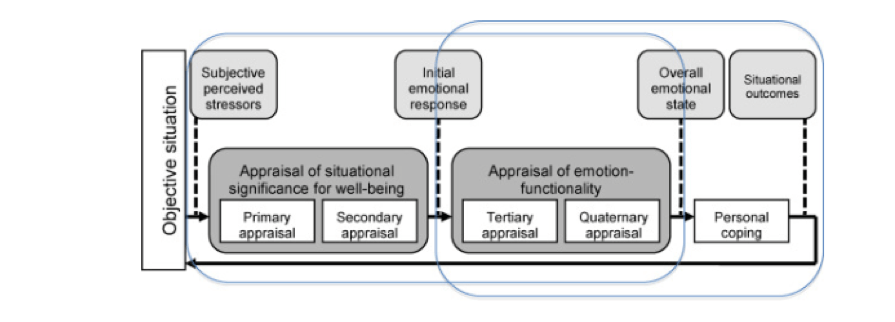
The stress-performance relationship, however, has been loosely understood[3,5]. Initially the WHY and HOW stress affects performance must be implicit, and only then solutions can be provided. This is what the Meta-Model of Stress, Emotion and Performance[4] aims to achieve (see Figure 1).
The “Meta-Model” comprises:
- Current theoretical understanding of stress response.
- Psychological processes leading to behavioural response.
- Significant explanatory potential for any performance domain (athletes, coaches, business managers etc.).
Thus, encompasses both, WHY stress occurs, and HOW it impacts performance.
The model presents 3 stages:
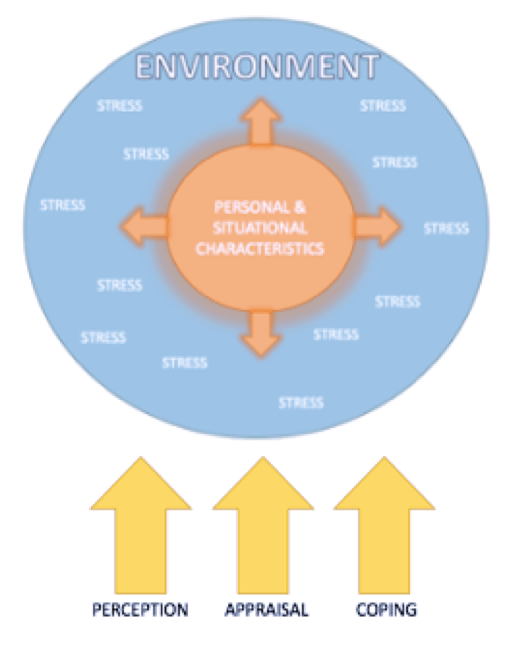
Stage 1: Person-Environment fit – stressors arise from interaction of environment and coach characteristics. Personal perceptions act here.
Stage 2: Emotion-Performance fit – negative feelings occur when emotional responses (e.g. anxiety) are seen as debilitative.
Stage 3: Coping and Overall Outcome – negative outcomes occur through lack of appropriate coping strategies.
Throughout the remainder of the blog, we will follow the Meta-Model to understand stress response in coaches and propose coping measures.
Causes of Coaching Stress
(Person-Environment Fit)
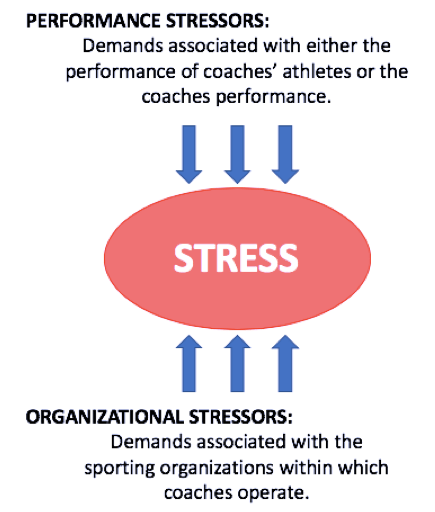
Stress can arise from variety of sources. Coaches are performers faced with expectations and pressures, additionally coaching is a job associated with occupational strains[1].
Thelwell and colleagues investigated demands impacting elite coaching performance[6]. As many as 182 distinct stressors were identified. These were categorized as athletes’ performance-related, coaching performance-related or organizational-related stressors (see Table 1 for classified themes).
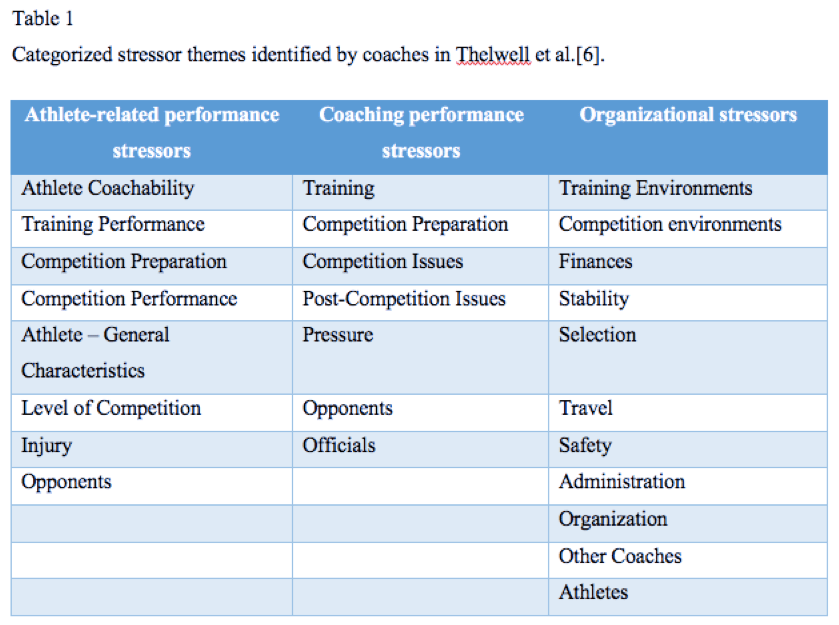
Identifying the specific causes of strain for coaches represents the first step to minimising coaching stress. Next, we need to understand HOW these coaching demands translate to a stress response.
Stage 1 of the Meta-Model is concerned with process of branding situations as stressful and initiating an emotional response. Specifically, stressors are a consequence of cognitive processes (appraisals) regarding the interaction between personal characteristics and the environment[4]. People innately evaluate the importance of events and assess the implications these have on their goals and well-being, resulting in an emotional response (e.g. anxiety, anger)[2]. Here, the model borrows from Lazarus and Folkman’s Transactional Model of Stress and Coping[7] (see Figure 2).
Appraisal: Evaluation of the consequences of the perceived demand[8].
Lazarus and Folkman introduce two appraisals[7]:
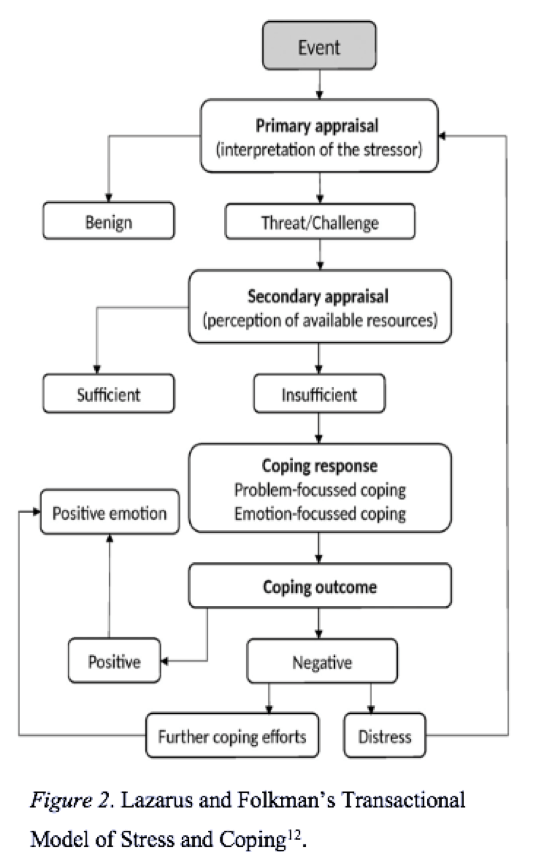
- Primary Appraisal:
- Evaluation regarding the personal stake in the event, and whether achievement of the goal is compromised.
- The coach evaluates the relevance of the stressor in the situation, and the personal significance for their well-being.
- “How does this affect me?”
- Three types of evaluation: benign, challenge and threat.
- Secondary Appraisal:
- When the demands are evaluated as meaningful, further evaluation focuses on the resources available to cope with the stressful encounter.
- The coach considers adopting problem-focused or emotion-focused coping if available.
- “What can I do about this?”
Primary and secondary appraisal, along with coaches’ personal characteristics, impact the initial emotional response to the event.
Impact of Stress on Coaching Performance
(Emotion-Performance Fit)
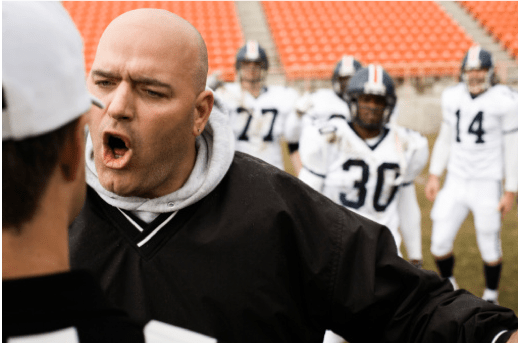
In Frey’s study of coaching stress[1], individuals were asked about the effects of stress which they frequently experience. Most coaches outlined the negative effects on their thoughts, behaviours and physiology. Most commonly cited was change in body language, becoming fidgety or tense, and changes in tone of voice, becoming quieter or ‘snappy’. Some coaches discussed becoming less emotionally stable and pointed towards their inability to focus. All of these experiences are common to a typical negative stress response experienced by all of us. Where coaching stress becomes distinct, is when the negative effects of stress begin impacting on coaches’ players performance. Some coaches identified that when they become stressed, they notice their players becoming tense with them. Yet, some coaches identified positive responses to stress. Typically, enhanced focus and motivation, and preparation for future events. So, why do some coaches experience positive, and others negative, effects of stress?
Stage 2 of the Meta-Model is interested in explaining just that. Here, the previously evaluated emotion is appraised further regarding its usefulness to the performance[9]. Is the emotion optimizing or dysfunctional towards the goal? This establishes emotional orientation[4].
Emotional Orientation: overall direction (positive/negative) of the emotional response associated with the demands[4].
The Meta-Model presents further two appraisals:
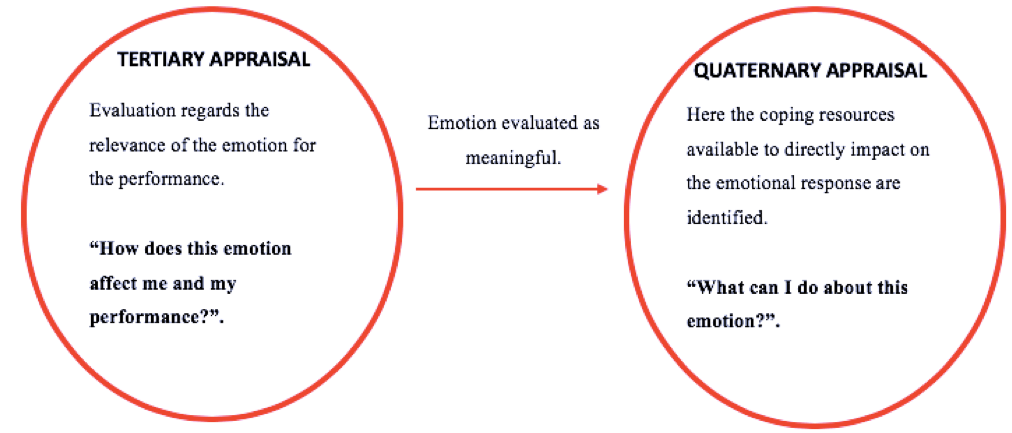
Emotional appraisal is an individualised process. Similarly, to primary and secondary appraisals, coaches’ personal and situational characteristics are identified as key motivators for varying evaluations among coaches[2]; self-esteem[10], self-efficacy[11], self-reliance[12], optimism/pessimism[13], learnt resourcefulness[14]. For example:
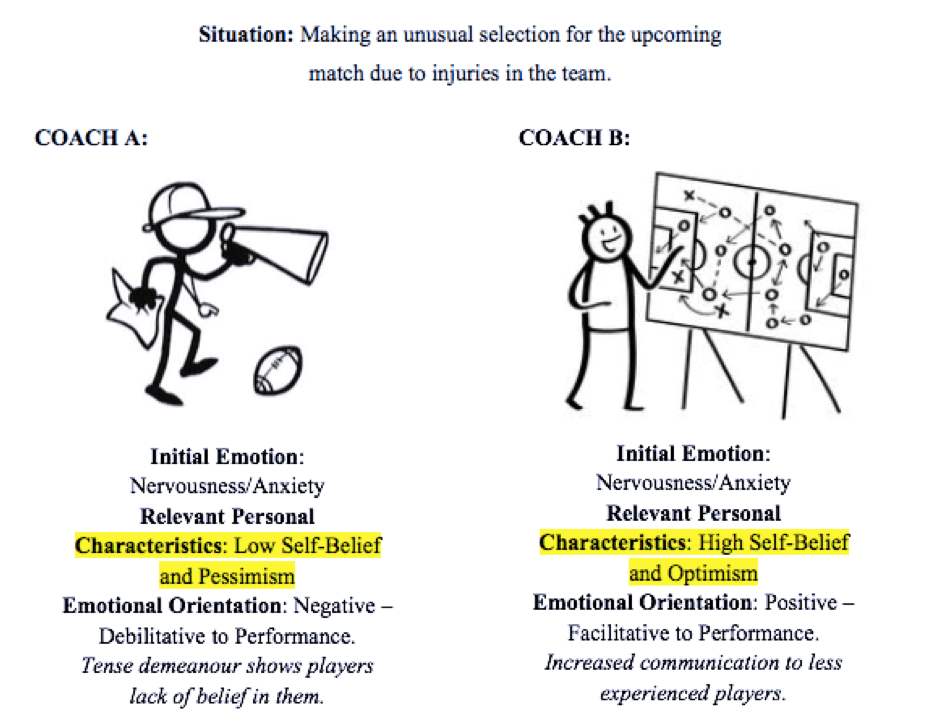
Therefore, two coaches, experiencing identical stressor, can interpret the emotional response as a discouragement (Coach A) or an incentive (Coach B).
When repeatedly evaluating emotional orientation as debilitative, coaches are likely to develop disengagement from the role, and eventually burnout[15].
Burnout: Psychological syndrome arising from chronic stress. It comprises of three dimensions: emotional exhaustion, depersonalization and reduced accomplishment[16].
Emotional Exhaustion: coaches experience feelings of complete reduction in emotional, physical and cognitive resources[17].
Depersonalization: coaches experience indifference and devaluation towards their role[17].
Reduced Personal Accomplishment: coaches experience a sense of inefficacy in their role[17].
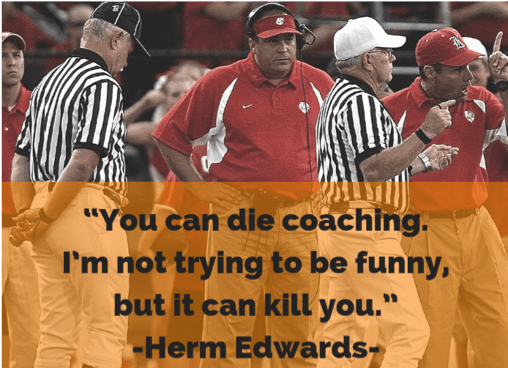
Burnout is an extreme outcome of stress affecting individual’s well-being and performance. It typically manifests as symptoms of frustration, anxiety, disturbed sleep, motivation loss, social withdrawal, emotional outbursts, and sometimes even physical illness[17]. Similarly to stress appraisal process, burnout is a highly individualised, and each coach experiences it differently. Yet, burnout is always debilitative to the individual, hence the importance of monitoring and coping with stressors within the coaching environment.
Coping with Coaching Stress
(Coping and Overall Outcome)
Finally, the Meta-Model describes how the emotional orientation is manipulated into the final performance outcome[4]. More specifically, unsuccessful coaching performance, poor coach well-being, and possible burnout symptoms, are outcomes of ineffective management of negative emotional orientation. Hence, Stage 3 focuses on coaches’ coping abilities.
Coping: “the cognitions and behaviours, adopted by the individual following the recognition of a stressful encounter, that are in some way designed to deal with that encounter or its consequences” (p. 7)[18]
Literature has identified two main coping approaches[2]:
- Problem-focused
- Coach will attempt to deal with the demands placed upon them by the environment.
- Coping strategies aiming to reduce quantity, frequency or intensity of the demands.
- Emotion-focused
- Coach will attempt to deal with their emotional orientation towards the stressor.
- Coping strategies aiming to change individuals’ responses by altering personal and situational moderators, leading to a re-appraisal.
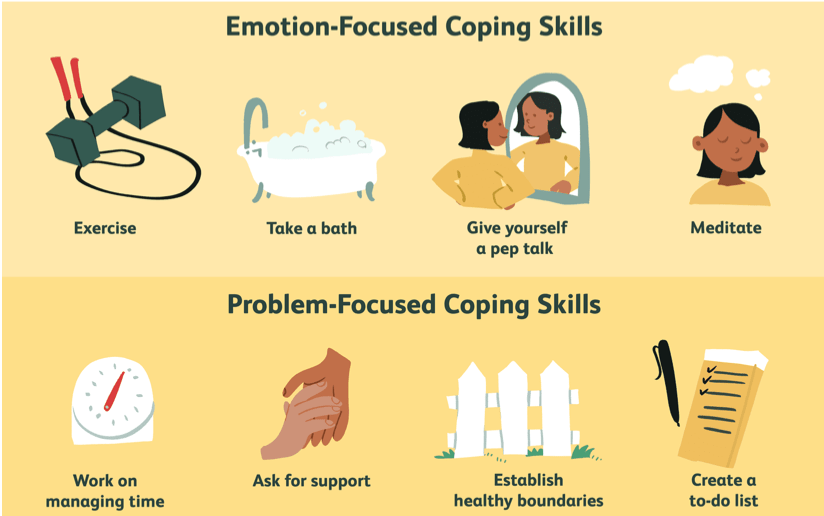
Studies aiming to uncover the strategies used by high performance coaches discover that a combination of problem-focused and emotion-focused coping is most frequently adhered to, and most effective[19]. Within these strategies, coaches will follow a range of cognitive or behavioural techniques. Interviews with Division I college coaches[1] aimed to uncover some of the strategies frequently used by coaches. Recurrently coaches mentioned “focusing on the controllable”, rather than contemplating aspects which cannot be changed (e.g. media, travel, weather). Problem-focused techniques which are likely to strengthen this association may include, but are not limited to, developing time management, delegation of responsibilities and learning assertiveness[20]. Coaches in Frey’s study[1], also spoke about emotion-focused techniques; re-focusing attention on sources of enjoyment, visualisation of pressures, contingency planning and ensuring maintenance of balanced lifestyle.
Additionally, elite coaches report beneficial effects of relaxation and imagery on emotional control when exposed to demands[6]. Importantly, successful coaches report using a combination of both coping strategies, and using variety of suitable techniques before, during and after coaching performance[19].
The effectiveness of the coping strategy is dependent on its suitability to the individual coach[2]. All four appraisals outlined by the Meta-Model are rooted in individualised perceptions and influenced by personal characteristics[4], consequently coping with the outcomes also requires specificity. Ineffective approaches lead to significant diminishments in coach’s well-being, and coaching performance. Contrariwise, effective stress management can lead to increased well-being, role satisfaction and better coaching performance[5]. Moreover, extended successful coping will ultimately result in experiences of ‘being in the zone’, or flow, within the coaching role[2].
Tips for Managing Coaching Stress and Burnout
Repeated stress and burnout are characterized with amplified negative thoughts, feelings and actions, which become increasingly difficult to overcome[21]. A coach who is repeatedly failing to cope with negative emotions, will exercise maladaptive actions, which will affect coaches present performance, and leave long-term strain transferrable to future performances. It soon becomes a “downward spiral”.
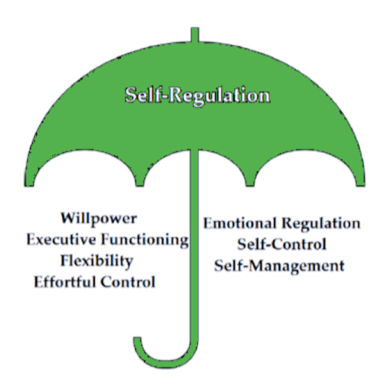
To avoid the acceleration of maladaptive stress response, coaches must be equipped with strategies to recognise and alter their responses. Self-regulatory competencies and strategies have been associated with “thriving” coaches[22].
Self-Regulation: Ability to plan, control, evaluate and adapt thoughts, feelings and actions, to represent personal goals and standards[23].
- Adopting the Social-Cognitive Model of Self-Regulated Learning and Performance[23].
Effective self-regulation occurs over three phases:
- Preparation: Coaches set personal goals, followed by outlining strategic plans to achieve those goals.
- e.g. coach outlines the short selection period as a stressor and plans to utilise time-management techniques to start thinking about selections earlier.
- Execution: Coaches carry out set out plans and monitor own performance and well-being.
- e.g. coach employs time-management techniques, such as timeline planning of the selection process, and monitors efficacy.
- Self-Reflection: Coaches evaluate the outcomes and adjust plans accordingly.
- e.g. coach actively reflects on the usefulness and efficacy of the overall selection process and suggests developments for future.
Coaches must develop personal and specific strategies in order to facilitate the three phases of self-regulation.
Through adopting this framework of self-regulation, coaches are given autonomy over their stress experience, and undergo stress management by adopting individualised strategies. Equally importantly, coaches are exposed to proactive and reactive stress management, encouraging for problem- and emotion-focused coping strategies. Proactively, during preparation, coaches anticipate stressors and aim to minimise the likelihood of experiencing them. While reactively, during execution coaches use emotional-control strategies to re-evaluate demands. While during self-reflection strategies are adapted to better combat the experienced stressors in the future.
Strongly beneficial self-regulatory effects are evidenced among elite coaches; perceived improvements in symptoms of burnout and well-being[24].
2. Mindfulness Meditation Facilitates Self-Regulation.
Mindfulness meditation can facilitate self-regulatory coaching performance, by developing robust self-regulatory techniques.
Mindfulness: Present-moment, non-judgemental, and accepting awareness of events. Meditation techniques rely on focusing attention on a specific event (e.g. breathing) and accepting the difficulty associated with the process[25].
Mindfulness meditation targets two distinct processes of self-regulation[26]:

- Attentional Control: capacity to direct/shift attention away from uncontrollable demands, resolve conflict between personal and environmental factors and inhibit debilitative actions.
- Emotion Regulation: capacity to modify how emotions are appraised and expressed.
Effective self-regulation techniques depend on a balance between the emotional reactivity and attentional control of the coach. Mindfulness meditation has been shown to develop these two capabilities among various performance domains, including athletes[27]. Therefore, it can be presumed that, through meditation, coaches will develop the necessary mechanisms to aid their self-regulation process.
Mindfulness meditation can be time-consuming, which will only add to the demands experienced by already busy coaches. So, I propose a short mindfulness training: 5 days per week, 20-minute sessions. This ‘express’ framework has previously shown improvements in self-regulation[28].
This blog aimed to provide scientific information regarding stress experience and burnout among coaches. I hope that after reading you are equipped with the necessary understanding of how stress can arise, and what can be done to minimise the debilitative effects of the demanding coaching environments. Of course, it is impossible to completely eradicate stress in coaching, but it is possible to alter the way coaches deal with stress. So, I propose that coaches should actively undertake self-regulatory interventions, and supplement this with mindfulness meditation.
Thank you for reading. Any comments, thoughts and opinions are greatly welcome!
Contact Details: P.Mazur-19@student.lboro.ac.uk
References:
[1] Frey, M. (2007). College coaches’ experiences with stress – “problem solvers” have problems too. The Sport Psychologist, 21, 38-57.
[2] Fletcher, D., Hanton, S., & Mellalieu, S. D. (2006). An organizational stress review: Conceptual and theoretical issues in competitive sport. In S. Hanton & S. D. Mellalieu (Eds.), Literature reviews in sport psychology (pp. 321–373). Hauppauge, NY: Nova Science.
[3] Olusoga, P., Butt, J., Hays, K., & Maynard, I. (2009). Stress in elite sports coaching: Identifying stressors. Journal of Applied Sport Psychology, 21(4), 442-459.
[4] Fletcher, D., & Fletcher, J. (2005). A meta-model of stress, emotions and performance: Conceptual foundations, theoretical framework, and research directions. Journal of Sports Sciences, 23(2), 157-158.
[5] Woodman, T., & Hardy, L. (2001). Stress and anxiety. In R. N. Singer, H. A. Hausenblas, & C. M. Janelle (Eds.), Handbook of sport psychology (pp. 290-318). New York: Wiley.
[6] Thelwell, R. C., Weston, N. J., Greenlees, I. A., & Hutchings, N. V. (2008). Stressors in elite sport: A coach perspective. Journal of Sports Sciences, 26(9), 905-918.
[7] Lazarus, R. S., & Folkman, S. (1984). Stress, appraisal, and coping. Springer publishing company.
[8] Lazarus, R. S. (1966). Psychological stress and the coping process. McGraw-Hill.
[9] Jones, G. (1995). Competitive anxiety in sport. In S. J. H. Biddle (Ed.), European perspectives on exercise and sport psychology (pp. 128-153). Champaign, IL: Human Kinetics.
[10] Ganster, D. C., & Schaubroeck, J. (1995). The moderating effects of self-esteem on the work stress-employee health relationship. Occupational Stress: A Handbook, 167-177.
[11] Schaubroeck, J., & Merritt, D. E. (1997). Divergent effects of job control on coping with work stressors: The key role of self-efficacy. Academy of Management Journal, 40(3), 738-754.
[12] Quick, J. C., Joplin, J. R., Nelson, D. L., Mangelsdorff, A. D., & Fiedler, E. (1996). Self-reliance and military service training outcomes. Military Psychology, 8(4), 279-293.
[13] Chang, E. C. (1998). Dispositional optimism and primary and secondary appraisal of a stressor: Controlling for confounding influences and relations to coping and psychological and physical adjustment. Journal of Personality and Social Psychology, 74(4), 1109-1120.
[14] Rosenbaum, M. (1990). The role of learned resourcefulness in the self-control of health behavior. Springer Publishing Co.
[15] Hassmén, P., Kenttä, G., Hjälm, S., Lundkvist, E., & Gustafsson, H. (2019). Burnout symptoms and recovery processes in eight elite soccer coaches over 10 years. International Journal of Sports Science & Coaching, 14(4), 431-443.
[16] Maslach, C., Jackson, S.E. & Leiter, M.P. (1996). Maslach burnout inventory manual (3rd ed.). Palo Alto, CA: Consulting Press.
[17] McNeill, K., Durand-Bush, N., & Lemyre, P. N. (2017). Understanding coach burnout and underlying emotions: a narrative approach. Sports Coaching Review, 6(2), 179-196.
[18] Dewe, P., Cox, T., & Ferguson, E. (1993). Individual strategies for coping with stress at work: A review. Work & Stress, 7(1), 5-15.
[19] Fletcher, D., & Scott, M. (2010). Psychological stress in sports coaches: A review of concepts, research, and practice. Journal of sports sciences, 28(2), 127-137.
[20] Taylor, J. (1992). Coaches are people too: An applied model of stress management for sports coaches. Journal of Applied Sport Psychology, 4, 27-50.
[21] Olusoga, P., & Kenttä, G. (2017). Desperate to quit: A narrative analysis of burnout and recovery in high-performance sports coaching. The Sport Psychologist, 31(3), 237-248.
[22] McNeill, K., Durand-Bush, N., & Lemyre, P. N. (2018). Thriving, depleted, and at-risk Canadian coaches: Profiles of psychological functioning linked to self-regulation and stress. International Sport Coaching Journal, 5(2), 145-155.
[23] Zimmerman, B. J. (2002). Becoming a self-regulated learner: An overview. Theory Into Practice, 41(2), 64-70.
[24] McNeill, K., Durand-Bush, N., & Lemyre, P. N. (2019). Can Learning Self-Regulatory Competencies Through a Guided Intervention Improve Coaches’ Burnout Symptoms and Well-Being?. Journal of Clinical Sport Psychology, 1, 1-21.
[25] Shapiro, S. L., Carlson, L. E., Astin, J. A., & Freedman, B. (2006). Mechanisms of mindfulness. Journal of Clinical Psychology, 62(3), 373-386.
[26] Kaunhoven, R. J., & Dorjee, D. (2017). How does mindfulness modulate self-regulation in pre-adolescent children? An integrative neurocognitive review. Neuroscience & Biobehavioral Reviews, 74, 163-184.
[27] Birrer, D., Röthlin, P., & Morgan, G. (2012). Mindfulness to enhance athletic performance: Theoretical considerations and possible impact mechanisms. Mindfulness, 3(3), 235-246.
[28] Tang, Y. Y., Ma, Y., Wang, J., Fan, Y., Feng, S., Lu, Q., … & Posner, M. I. (2007). Short-term meditation training improves attention and self-regulation. Proceedings of the National Academy of Sciences, 104(43), 17152-17156.
 Stress-Less Coaching! Understanding and Tackling Coaching Stress.
As a tennis coach I found this blog very informative and relatable. I will be sure to use some of the tips to reduce stress levels when coaching.
LikeLike
Great read thoroughly enjoyed!
LikeLike